Imagine stepping into the Derbyshire countryside and discovering that, for the next hour and a half, your companion has four legs, large soulful eyes and a naturally unhurried way of seeing the world.
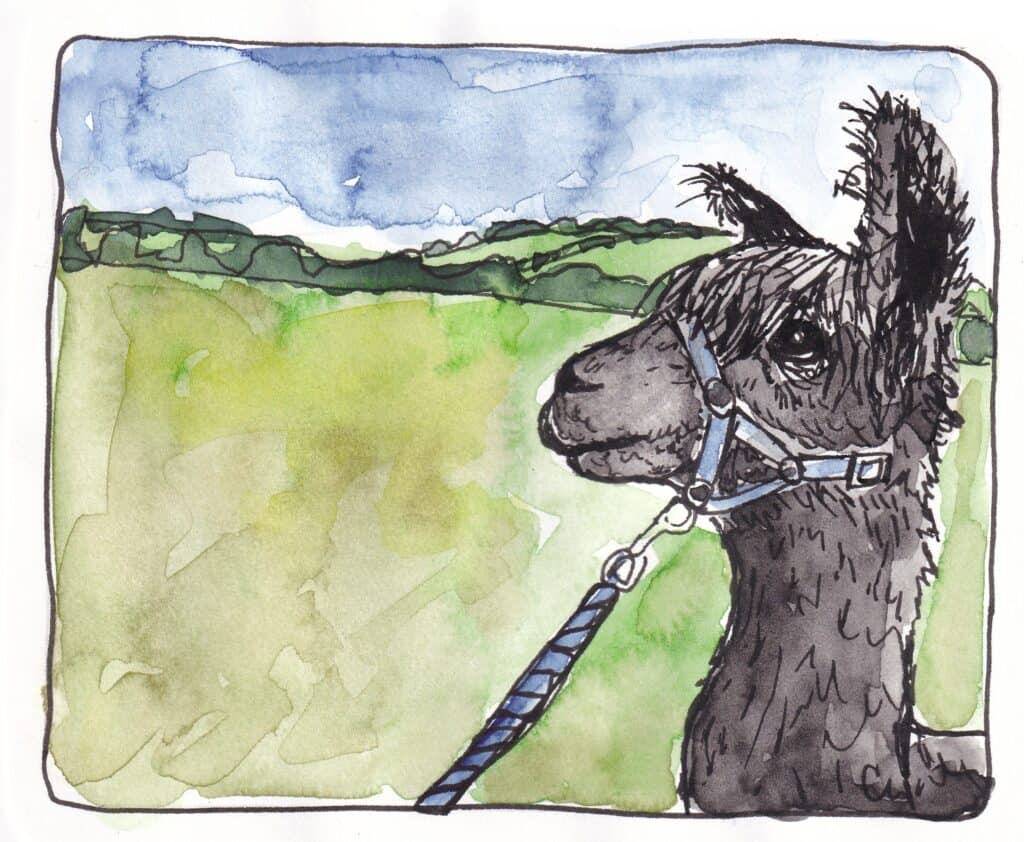
Your Alpaca companion sets the pace as you wander through the fields, the soft grass beneath your feet and a cool breeze rushing through your hair. A sturdy red rope connects you to your new friend, who walks beside you with a slow, rhythmic sway, his soft coat catching the light in rich shades of molten chocolate and warm caramel. Every now and then, he brushes against you, inviting your hand to reach out and feel his soft fleece.
Those soulful eyes, framed by thick eyelashes, seem to take in everything around him. An interesting plant can bring the whole expedition to a halt as he bends his long neck to investigate, completely unconcerned about time or place. When your Alpaca pauses, you begin to notice all the little things you might have walked straight past.
Around you, the Derbyshire countryside carries on with its own gentle soundtrack. Birds sing from the trees, branches creak softly as they sway in the breeze and the landscape seems to breathe around you. Somewhere amongst it all comes a gentle hum, as though your companion is quietly singing as you stand together.
The air smells of wildflowers and fresh open land, and the hills stretch away towards the horizon. Slowly, you begin to match the pace of your companion, discovering that the best way to explore Derbyshire might just be to let an Alpaca decide where to stop.
Walking at an Alpacas Pace
There is something magical that happens when you walk among Alpacas. Your breath begins to slow. Your thoughts stop spinning. Somehow, without saying a word, your Alpaca seems to ask a very simple question.
Why are you rushing?
Alpacas live at a different pace. They are highly attuned to the world around them, always watching, always listening, noticing the smallest changes in their surroundings. They do not hurry simply because there is somewhere else to be. They wander, pause, look, listen and carry on when they are ready.
Walking alongside them invites us to do the same.
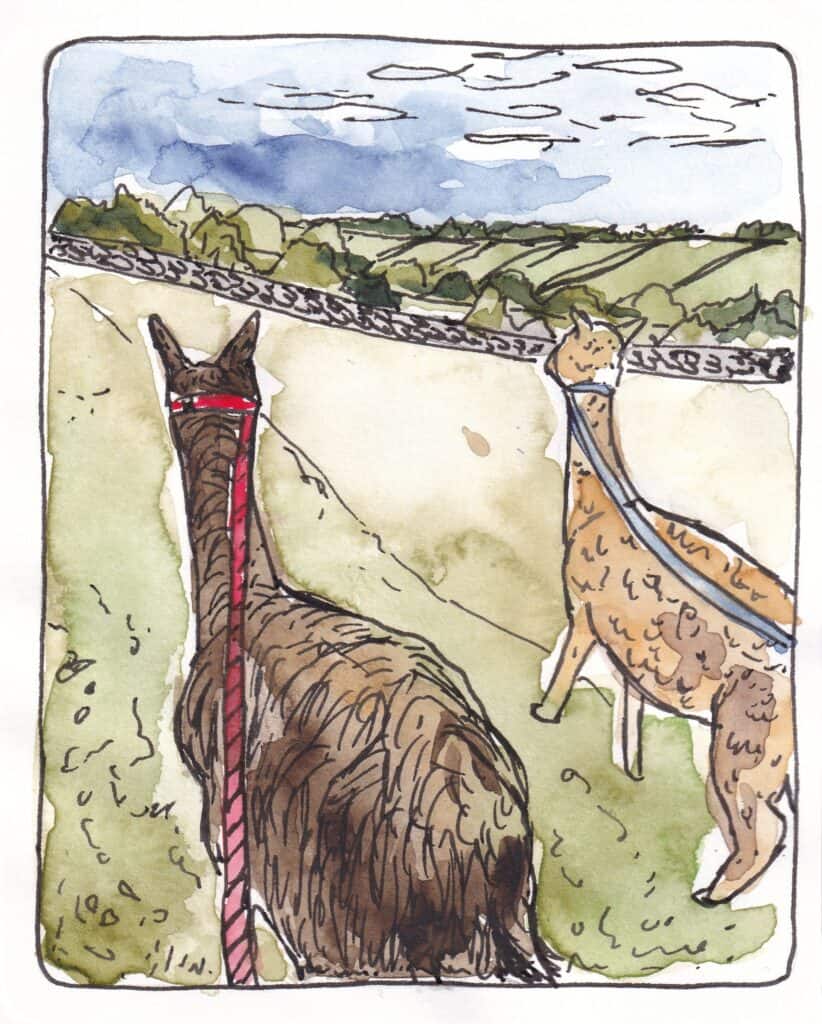
For a little while, you can step away from the constant doing and simply be. You notice the sound of the Alpaca’s footsteps beside you. The breeze whispering through the Derbyshire hills and the landscape unfolding around you. The curious, gentle face looking at you seems to say, I am here. We are together.
Alpacas mainly communicate through gentle hums. It is a quiet conversation, a little reminder that not everything needs to be loud in order to be heard.
Perhaps that is one of the things Alpacas can teach us. You do not need to shout to be strong. There is strength in standing firm, in listening deeply, in looking after those around you and in moving through the world with quiet confidence.
And then there is their curiosity. An Alpaca notices things. A rustle in the grass. A bird overhead. Something interesting just beyond the path. They remind us to pay attention to the little things, because sometimes those are the magical moments that we would have hurried straight past.
For a while, you get to see Derbyshire through an Alpaca’s eyes. A little slower. A little quieter. A little more curious.
The Alpacas know the pace of nature.
Perhaps, as you walk beside them, they will help you to learn it too.
A very extraordinary history
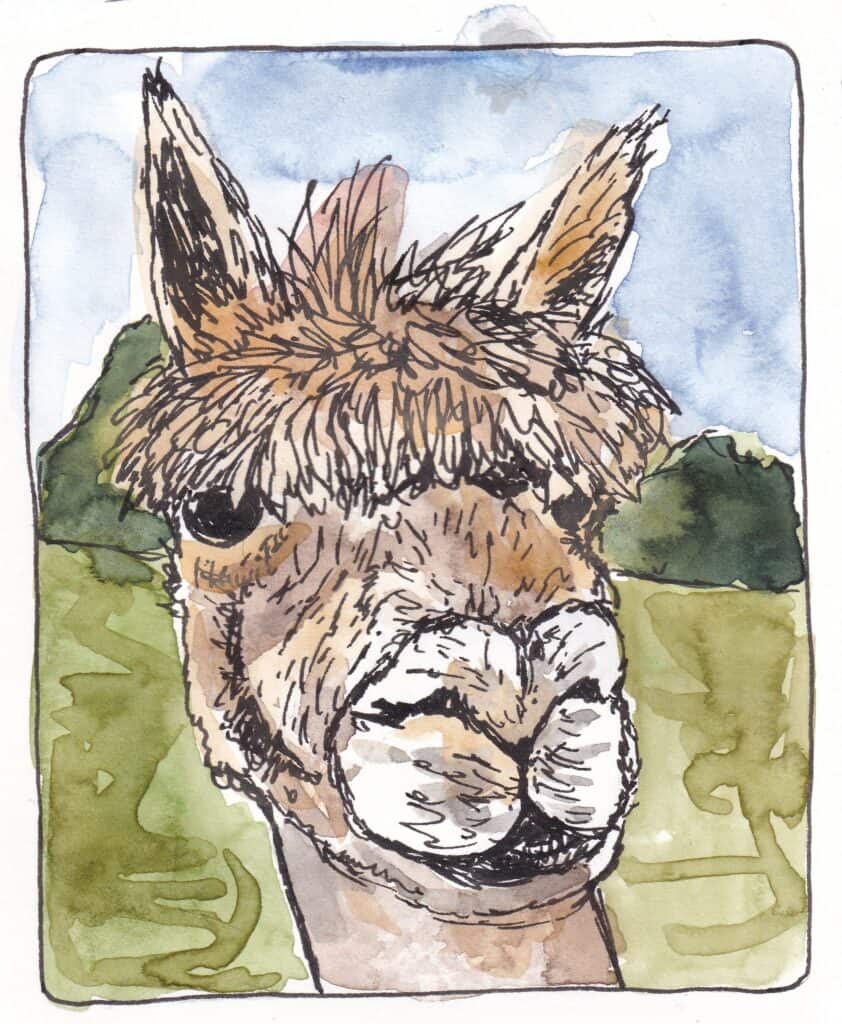
Long before Alpacas wandered through the Derbyshire countryside, they belonged to a very different world.
Their story begins high in the mountains of South America, where Alpacas were domesticated around 9,000 years ago. For the ancient Inca people, they were far more than simply beautiful animals with an extraordinarily soft fleece. Alpacas were precious, and their fleece was made into clothing worn by royalty.
At the height of the Inca Empire, an astonishing 50 million Alpacas are thought to have lived across South America.
Then, in 1532, everything changed.
The Spanish invaded South America, and in the years that followed, around 98 percent of the Alpaca population were killed. Some were eaten, while others were slaughtered to clear the grazing land needed for sheep brought over from Europe.
But the Alpacas that survived had somewhere to hide.
The Incas took their precious animals high into the Andes, retreating into the highest and most remote mountains. It was a desperate escape, but those hidden herds would ultimately save the species.
And perhaps this is one of the reasons Alpacas seem to have such a mysterious quality today. Their ancestors survived by disappearing into the mountains.
From the Andes to a Victorian wardrobe
For centuries, Alpacas remained largely unknown in Britain. Then, in Victorian England, their extraordinary fleece caught the attention of a man called Sir Titus Salt.
One day, Sir Titus Salt discovered several unloved bales of Alpaca fleece sitting in a warehouse in Liverpool. After buying them cheaply, he spent a whole year secretly experimenting with techniques to turn the Alpaca fleece into yarn.
Eventually, he succeeded.
A coat was made from the newly created Alpaca yarn and presented to Prince Albert, who in turn gave it to Queen Victoria. The Victorian fashion world was captivated.
Alpaca fabric became extraordinarily fashionable, and these beautiful garments were so prized that some were even left to relatives in people’s wills.
Imagine that. An Alpaca coat was once precious enough to be inherited.
There were attempts to bring live Alpacas to Britain during this period, but they failed. For another 150 years, Alpacas remained something of a mystery to the British public. They were exotic creatures from distant mountains, known mainly for the extraordinary fleece that had somehow found its way into Victorian wardrobes.
And then they came to Britain
It wasn’t until the early 1990s that Alpacas could finally make the journey here properly.
A change in Peruvian law allowed Alpacas to be exported, and the first animals began their long journey to Britain. They were incredibly expensive to transport, but little by little, these curious creatures began to find a new home on British farms.
Today, around 35,000 Alpacas live in Britain.
And that brings their extraordinary journey right here to Derbyshire.
So when you meet an Alpaca on the hillside at Brackenfield, you’re not simply meeting a rather adorable animal with enormous eyes and a calm demeanor.
You’re meeting a survivor.
An animal whose ancestors escaped into the highest mountains of the Andes, whose fleece once clothed Inca royalty and enchanted Victorian Britain, and whose journey across the centuries has finally brought them to the Derbyshire countryside.
Which makes walking beside them feel rather special.
Listen to the Alpacas
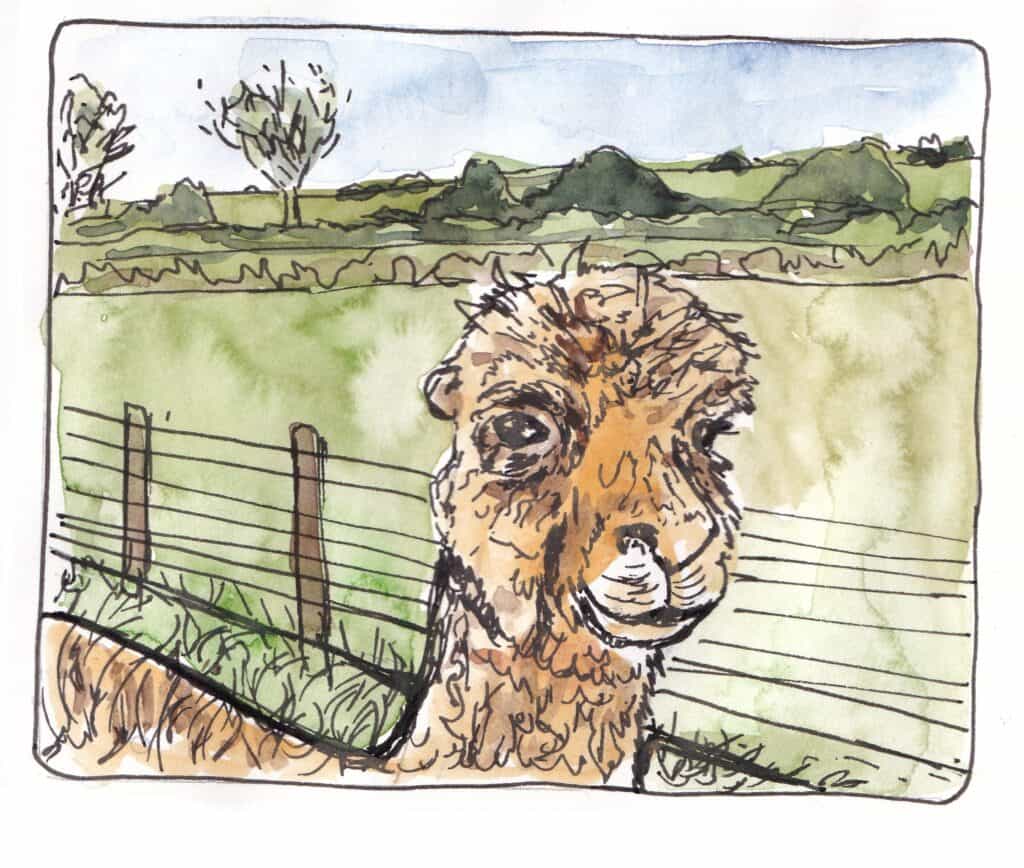
Once you are walking alongside an Alpaca, something rather magical begins to happen. You start to notice that they are not as quiet as they first appear.
Listen closely and you may hear a soft, gentle hum.
It sounds a little bit like the purr of a cat, and every Alpaca has their own distinctive sound. Some hum quietly, almost beneath their breath, while others are more enthusiastic. Their hums can rise and fall in pitch and volume, carrying different messages depending on how they are feeling.
An Alpaca might hum because they are curious about something happening nearby. They might hum when they are happy, cautious or feeling a little stressed.
Watch a herd for a while and you may hear them humming back and forth, one answering another in a calm conversation between herd mates. It is one of those moments that is easy to miss, but when you slow down and listen, you begin to realise that there is a whole conversation happening around you.
The sweetest conversation of all belongs to a mother and her cria, which is the name given to a baby Alpaca. Mothers will hum softly to their babies and the little ones often hum back. They also have another gentle way of communicating. A mother may make a soft clucking sound to comfort her baby and encourage them to stay close.
But not every Alpaca sound is quite so peaceful.
If one of them spots something they believe could be a threat, they can let out a surprisingly loud, high pitched squeal or whistle. This is their alarm call, a very effective way of letting the rest of the herd know that something has caught their attention and bringing everyone together.
And then there are the conversations that happen without a sound at all.
An Alpaca’s ears are constantly telling a story. Ears pointing forwards and standing alert usually mean that something has caught their attention. Perhaps they are curious about you.
Ears pinned back can mean an Alpaca is annoyed or frightened, while ears held half way back often suggest that they are relaxed or sleepy. If you see their ears swivelling in different directions, they are quietly monitoring the sounds around them, from a distant bird call to the rustle of the Derbyshire countryside.
Their tails have a story to tell too.
When an Alpaca’s tail rests flat against their body, they are usually feeling relaxed.
Sometimes you might see a younger Alpaca flip its tail upwards, curling it over its back. This is a wonderfully subtle piece of Alpaca etiquette. The raised tail is a submissive signal, telling an older member of the herd that they mean no harm and are not a threat. It is almost as though the younger Alpaca is politely saying, I’m friendly.
So when you meet the Alpacas, take a little time to watch and listen.
Notice the soft humming between friends. Look at their ears. Watch their tails. You might arrive thinking you are simply going for a walk with an Alpaca, but before long you will find yourself becoming part of a much quieter conversation, one spoken in hums, whistles and the smallest movements.
A Day Among the Alpacas
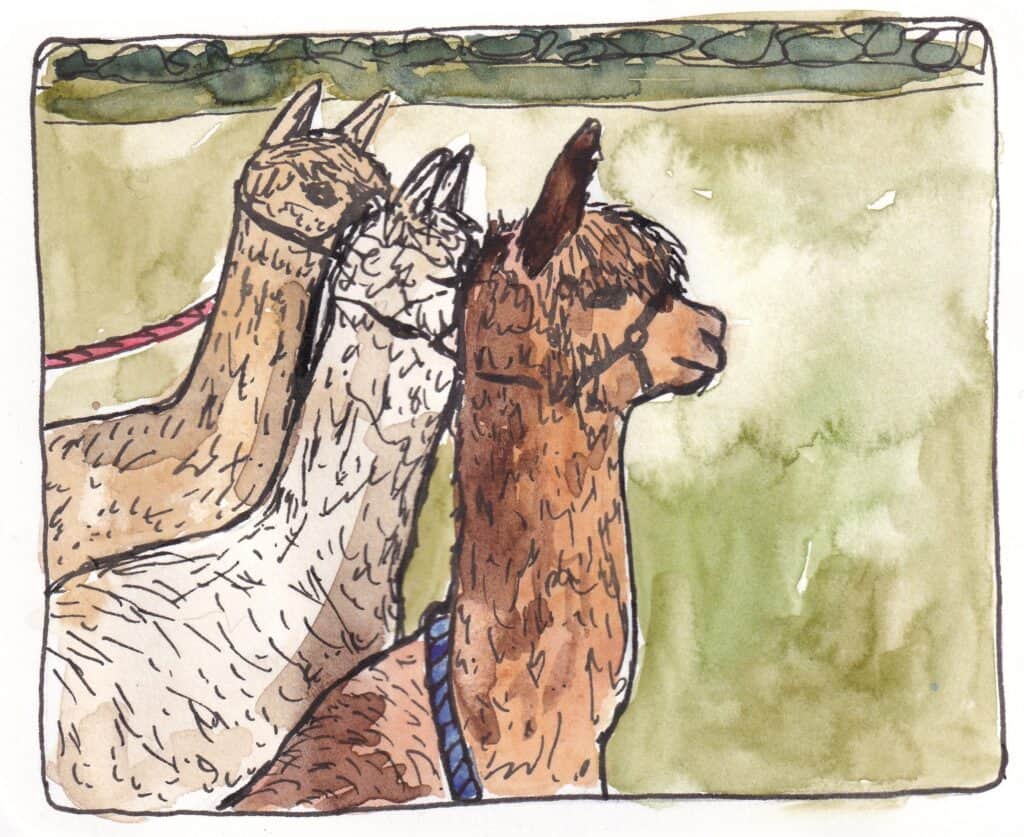
Your Alpaca adventure begins at a beautiful farm in Brackenfield, nestled among the rolling hills of the Amber Valley, surrounded by the Derbyshire countryside that makes you want to stop and simply take it all in. Green hills rise and tumble into the distance, hedgerows weave their way across the landscape and the farm sits quietly amongst it all.
There is something wonderfully peaceful about arriving here, as though you have crossed the threshold into a slower, gentle side of Derbyshire, where the countryside invites you to pause and take a breath.
Inside a gorgeous old barn, your human guide begins with an introduction to these enchanting animals. You will learn about Alpacas, their personalities and the little ways they communicate, giving you a whole new appreciation for the animals you are about to meet. The experience lasts around 90 minutes, including your introduction and time spent walking with your Alpaca.
Then comes the moment you have been waiting for. You are introduced to your Alpaca walking companion, ready to set off together into the Derbyshire countryside. There is something rather magical about wandering through the landscape with an Alpaca by your side, taking in the rolling hills and the peaceful countryside around you.
When you return from your trek, the adventure is not quite over. You can step into the paddock and meet the whole herd, with the chance to feed the Alpacas and spend a little more time in their company. There is something wonderfully memorable about standing among them, surrounded by soft noses, curious faces and the gentle hum.
Then it is back to the barn for a well deserved cup of tea. The barn is home to a collection of lovely Alpaca keepsakes to purchase, so that you can take a little piece of the experience home with you. There are keyrings made from Alpaca fleece, and you may even be able to find one made from the fleece of your very own Alpaca companion.
If you have fallen in love with the softness of Alpaca fleece, you can purchase some to take some home for spinning and crafts. There is something rather special about knowing that your next creative project began its journey here, among the Alpacas and the rolling hills of the Amber Valley.
You can even buy a mug featuring photographs of the Alpacas, so that one of those gentle faces can keep you company long after your visit has ended.
There are days out that you remember for the places you have seen, and then there are days that stay with you because of how they made you feel. An afternoon among the Alpacas is one of those days.
Somewhere amongst the rolling hills of the Amber Valley, surrounded by gentle animals and beautiful countryside, the world seems to slow down just enough for you to notice how magical it really is.